Checked
About Winnipeg, Manitoba: a newcomer's and visitor's guide
Winnipeg, Manitoba, Canada
What to know about Winnipeg, Manitoba's capital: where it is, 2021 Census population and the 2025 estimate, neighbourhoods, Winnipeg Transit, jobs, cold winters in numbers, languages, hospitals, universities and landmarks.
Key information
Winnipeg is the capital and largest city of Manitoba, where the Red and Assiniboine rivers meet, about 100 km north of the United States border. It had 749,607 people in the 2021 Census and Statistics Canada estimated 850,260 on July 1, 2025.
On this page
Winnipeg at a glance
| Fact | Winnipeg |
|---|---|
| Province and country | Manitoba, Canada (provincial capital) |
| Population, 2021 Census | 749,607 (6th largest municipality in Canada) |
| Population, 2016 Census | 705,244 (growth of 6.3% to 2021) |
| Statistics Canada estimate, July 1, 2025 | 850,260 (8,245 more people than a year earlier) |
| Winnipeg metro area, 2021 Census | 834,678 (about 952,000 estimated in 2025) |
| Land area | 461.78 km² (1,623.3 people per km² in 2021) |
| Incorporated as a city | 1873 |
| Unicity amalgamation | 1972 |
Winnipeg is Manitoba's capital and its economic and cultural centre. It is the sixth-largest municipality in Canada by 2021 Census population, and since 1972 one city government has covered the old city and its former suburbs.
Sources: Statistics Canada: Population and dwelling counts, census subdivisions (table 98-10-0002-01) · Statistics Canada: Population estimates, July 1, census subdivisions (table 17-10-0155-01) · City of Winnipeg: Statistics Canada: Winnipeg tops 850,000 residents (January 20, 2026) · Statistics Canada: Population and dwelling counts, census metropolitan areas (table 98-10-0005-01) · Statistics Canada: Population estimates, July 1, census metropolitan areas (table 17-10-0148-01) · The Canadian Encyclopedia: Winnipeg
Where is Winnipeg?
Winnipeg sits at the meeting point of the Red River and the Assiniboine River, about 100 km north of the Minnesota border and 65 km south of Lake Winnipeg. It lies close to the geographic centre of North America, roughly midway between the Atlantic and Pacific oceans, which once earned it the nickname "Bull's Eye of the Dominion".
The city is on flat prairie land at the edge of the Canadian Shield. That flat land and the meeting rivers explain both its fur trade past and its long fight against spring floods.
Sources: The Canadian Encyclopedia: Winnipeg
How many people live in Winnipeg?
- 2016 Census705,244 people
- 2021 Census749,607 people
- 2025 estimate850,260 people
The 2021 Census counted 749,607 people, up 6.3% from 705,244 in 2016. Statistics Canada's July 1, 2025 estimate is 850,260. The City says Winnipeg added 8,245 residents in 2025, the fifth-highest increase of any Canadian municipality. Estimates are adjusted for people the census missed, so they are not directly comparable with census counts.
Winnipeg is one of Canada's most diverse cities. In 2021, about 34% of residents belonged to a visible minority group, with Filipino residents the largest (10.9%), and 12.4% of residents were Indigenous.
Sources: Statistics Canada: Population and dwelling counts, census subdivisions (table 98-10-0002-01) · Statistics Canada: Population estimates, July 1, census subdivisions (table 17-10-0155-01) · City of Winnipeg: Statistics Canada: Winnipeg tops 850,000 residents (January 20, 2026) · The Canadian Encyclopedia: Winnipeg
Main areas and neighbourhoods
Early river lots and fur trade trails shaped the street pattern, and the railway later split the city in two. In 1972 the old city and its suburbs, including the francophone community of St. Boniface, were joined into one city nicknamed Unicity.
- Downtown and Portage and Main: the business core around Winnipeg's most famous intersection.
- The Exchange District: one of the most historically intact turn-of-the-century districts, full of early 1900s warehouses and banks.
- The Forks and Waterfront Drive: the river junction, market and newer downtown housing.
- St. Boniface: the historic French-speaking community across the Red River.
- The North End: north of the rail yards, home to many Slavic and Jewish immigrant families in the early 1900s.
- Chinatown and Corydon Avenue (Little Italy): neighbourhoods renewed from the 1980s.
- Suburbs to the west and south, which grew fastest after 1960.
Sources: The Canadian Encyclopedia: Winnipeg
How do people get around Winnipeg?
Winnipeg Transit runs the city's buses. On June 29, 2025, it launched the Primary Transit Network, the biggest change in its 142-year history. Frequent "spine" routes go in and out of downtown, and feeder routes connect neighbourhoods to them. The Blue Line rapid transit corridor, which opened in 2020, was the first part of this model.
Two days earlier, on June 27, 2025, the City reopened Portage and Main to people on foot for the first time in 46 years. Pedestrians can now cross in all four directions.
Sources: City of Winnipeg: Winnipeg Transit launches the Primary Transit Network (includes the City's land and water acknowledgement) · CP24: Portage and Main reopens to foot traffic (June 27, 2025)
What are the main jobs and employers?
Winnipeg produces most of Manitoba's manufactured goods and most of its retail sales. Its economy is spread across finance and insurance, manufacturing, aerospace, transportation, life sciences, and information and communication technology, and the public sector is a major employer.
It is still the centre of Canada's grain industry and home to the country's only commodity exchange, ICE Futures (formerly the Winnipeg Commodity Exchange). The Royal Canadian Mint makes Canada's circulation coins here, plus coins for other countries.
Sources: The Canadian Encyclopedia: Winnipeg · The Canadian Encyclopedia: Royal Canadian Mint · Royal Canadian Mint: Celebrating 50 years of minting in Winnipeg
What is Winnipeg's weather like?
| Month | Daily average | Average high | Average low | Precipitation |
|---|---|---|---|---|
| January | -16.3 °C | -11.4 °C | -21.2 °C | 18.0 mm |
| April | 3.8 °C | 10.0 °C | -2.5 °C | 32.5 mm |
| July | 19.5 °C | 25.8 °C | 13.2 °C | 76.6 mm |
| October | 5.1 °C | 10.4 °C | -0.2 °C | 38.1 mm |
| Whole year | 2.9 °C | 8.6 °C | -2.8 °C | 519.2 mm (126.2 cm of snow) |
Winnipeg has long, very cold winters and warm summers. January averages -16.3 °C, with average lows of -21.2 °C, while July averages 19.5 °C. The air is dry: the city gets about 519 mm of precipitation a year, including 126.2 cm of snow, and about 12 days a year above 30 °C.
The coldest temperature recorded at the airport station is -45.0 °C on February 18, 1966. The hottest is 40.6 °C on August 7, 1949.
Sources: Environment and Climate Change Canada: 1991 to 2020 Climate Normals, Winnipeg Richardson (Airport)
What languages are spoken in Winnipeg?
English is the main language. In the 2021 Census, English was the only mother tongue of 65.2% of residents, French of 2.8%, and a language other than English or French of 26.7%. About 9.7% (71,705 people) could speak both English and French.
St. Boniface keeps a strong French-speaking community, and the Université de Saint-Boniface and Festival du Voyageur are centres of francophone life in Western Canada.
Sources: Statistics Canada: Mother tongue and knowledge of official languages, 2021 Census (table 98-10-0170-01) · The Canadian Encyclopedia: Winnipeg · Festival du Voyageur: About
Main hospitals, universities and colleges
- Health Sciences Centre (HSC): Manitoba's main hospital for trauma, neurosurgery, burns, transplants and psychiatric care, run by Shared Health.
- St. Boniface Hospital, Grace Hospital, Concordia Hospital, Seven Oaks General Hospital and Victoria Hospital, listed by the Winnipeg Regional Health Authority.
- University of Manitoba: founded in 1877, the first university in Western Canada.
- Université de Saint-Boniface: traces its roots to 1818.
- University of Winnipeg and Red River College.
Sources: Shared Health: Health Sciences Centre Winnipeg · Winnipeg Regional Health Authority: Hospitals · The Canadian Encyclopedia: University of Manitoba · The Canadian Encyclopedia: Winnipeg
Landmarks and what Winnipeg is known for
Winnipeg is known as the Gateway to the West, for its hard winters, the Jets and Blue Bombers, the Royal Winnipeg Ballet and as the city that gave Winnie-the-Pooh his name.
- The Forks: a meeting place for more than 6,000 years and now a market and park with about four million visits a year.
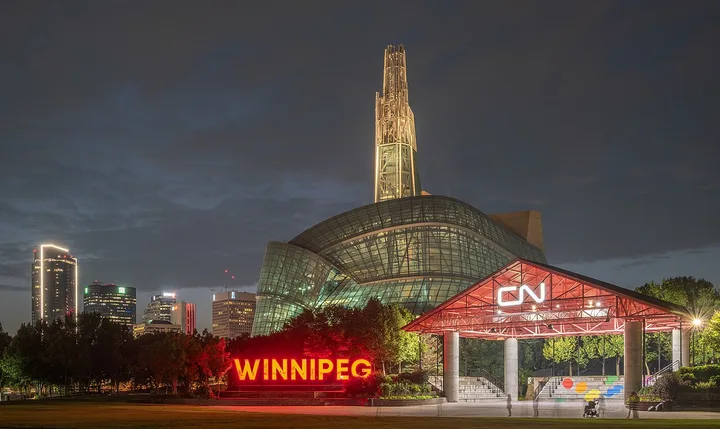
- Canadian Museum for Human Rights: opened on September 19, 2014 beside The Forks.
- Manitoba Legislative Building and the gilded Golden Boy statue on its dome.
- Exchange District: early 1900s warehouses, banks and theatres.
- Winnipeg Art Gallery: home to the world's largest collection of contemporary Inuit art.
- Royal Canadian Mint, Assiniboine Park Zoo and, north of the city, Lower Fort Garry.
- Festival du Voyageur each February, the largest francophone event in Western Canada.
Sources: The Forks: History · The Canadian Encyclopedia: Canadian Museum for Human Rights · The Canadian Encyclopedia: Golden Boy · The Canadian Encyclopedia: Winnipeg · Festival du Voyageur: About
Questions people ask about Winnipeg
What is the population of Winnipeg?
The 2021 Census counted 749,607 people. Statistics Canada estimated 850,260 on July 1, 2025.
Source: City of Winnipeg: Statistics Canada: Winnipeg tops 850,000 residents (January 20, 2026)
What is Winnipeg known for?
The Forks, cold winters, the Jets and Blue Bombers, the Royal Winnipeg Ballet, the Canadian Museum for Human Rights and being the namesake of Winnie-the-Pooh.
How cold does Winnipeg get?
January averages -16.3 °C with average lows of -21.2 °C. The airport's record low is -45.0 °C on February 18, 1966.
Source: Environment and Climate Change Canada: 1991 to 2020 Climate Normals, Winnipeg Richardson (Airport)
How much snow does Winnipeg get?
About 126.2 cm a year on average (1991 to 2020 normals). Winters are cold but fairly dry.
Source: Environment and Climate Change Canada: 1991 to 2020 Climate Normals, Winnipeg Richardson (Airport)
What does the name Winnipeg mean?
It comes from the Cree name for Lake Winnipeg, win-nipi, meaning "murky water".
Is Winnipeg the capital of Manitoba?
Yes. Winnipeg is the capital and largest city of Manitoba.
Can you walk across Portage and Main?
Yes. The City reopened the intersection to pedestrians on June 27, 2025, after 46 years of barricades.
Source: CP24: Portage and Main reopens to foot traffic (June 27, 2025)
What Treaty territory is Winnipeg on?
Treaty One Territory, the home and traditional lands of the Anishinaabe (Ojibwe), Ininew (Cree) and Dakota peoples, and the National Homeland of the Red River Métis.
How many people speak French in Winnipeg?
In 2021, 9.7% of residents could speak both English and French, and 2.8% had French as their only mother tongue.
What is the biggest hospital in Winnipeg?
Health Sciences Centre is Manitoba's main hospital for trauma, neurosurgery, burns and transplants.