Checked
History of Winnipeg, Manitoba: from The Forks and Treaty One to today
Winnipeg, Manitoba, Canada
A short history of Winnipeg, Manitoba: 6,000 years at The Forks, Treaty One and the Red River Métis, the Red River Colony and Resistance, the railway boom, the 1919 General Strike, floods, Unicity and a full timeline.
Key information
People have gathered at The Forks, where the Red and Assiniboine rivers meet, for more than 6,000 years, and Winnipeg is on Treaty One Territory and in the National Homeland of the Red River Métis. The fur trade posts and Red River Colony grew into a city incorporated in 1873, which boomed with the railway and became Manitoba's capital.
On this page
6,000 years at The Forks
The City of Winnipeg's acknowledgement says Winnipeg is located in Treaty One Territory, the home and traditional lands of the Anishinaabe (Ojibwe), Ininew (Cree) and Dakota peoples, and in the National Homeland of the Red River Métis, and that its drinking water comes from Shoal Lake 40 First Nation in Treaty Three Territory.
The meeting of the Red and Assiniboine rivers, known in Cree as Nestawaya, has been a gathering place for more than 6,000 years. Early visitors were likely hunters who came seasonally to fish and hunt bison. From about 1000 CE, Algonquian-speaking peoples camped here for long periods, and from about 1300 the Anishinaabe, Cree and Nakota (Assiniboine) used the area to fish and trade.
Sources: City of Winnipeg: Winnipeg Transit launches the Primary Transit Network (includes the City's land and water acknowledgement) · The Forks: History · The Canadian Encyclopedia: Winnipeg
Where does the name Winnipeg come from?
The name comes from the Cree name for Lake Winnipeg, win-nipi, meaning "murky water". The lake is 65 km north of the city.
Sources: The Canadian Encyclopedia: Winnipeg
Fur trade forts and the Red River Colony (1738 to 1869)
Pierre Gaultier de La Vérendrye ordered Fort Rouge built at The Forks in 1738. The North West Company built Fort Gibraltar in 1810, and Fort Garry followed. Cree, Nakota and Métis people were essential to the fur trade as hunters, trappers, traders and suppliers.
In 1811 the Hudson's Bay Company granted the Earl of Selkirk a huge area he called Assiniboia, and Scottish settlers founded the Red River Colony in 1812. Rivalry with the North West Company led to the violent Seven Oaks incident in 1816, in which Governor Robert Semple was killed. Through years of hardship, the colony grew into a multiracial society.
Sources: The Canadian Encyclopedia: Winnipeg · The Canadian Encyclopedia: Red River Colony · The Forks: History
The Red River Resistance and the Manitoba Act (1869 to 1870)
When the Hudson's Bay Company's lands were transferred to Canada, the Métis of Red River feared for their land and culture. In November 1869, led by Louis Riel, they stopped Canadian officials from entering the colony and formed a provisional government to negotiate terms. The execution of Thomas Scott in 1870 inflamed opinion in Ontario.
Negotiations in Ottawa led to the Manitoba Act, which created the province of Manitoba on May 12, 1870.
Treaty 1 (1871)
First Nations in the region had asked for a treaty since the late 1850s, including a petition from Chief Peguis in 1857. Treaty 1, the first of the 11 Numbered Treaties, was signed on August 3, 1871 at Lower Fort Garry (the Stone Fort) between Canada and the Anishinabek and Swampy Cree of southern Manitoba. It covers the land where Winnipeg stands.
Incorporation and the railway boom (1873 to 1914)
Winnipeg grew from Henry McKenney's 1862 store at the crossing that became Portage and Main. It was incorporated as a city in 1873, and when the first council met in 1874 it had about 3,700 people.
The Canadian Pacific Railway was completed in 1885, and Winnipeg became the wholesale, administrative and financial centre of the West. Immigrants passed through sheds at The Forks on their way west, and by 1911 Winnipeg was Canada's third-largest city. The Shoal Lake aqueduct, built from 1913 to 1919, was sized for a city expected to become the "Chicago of the North".
Sources: The Canadian Encyclopedia: Winnipeg · The Forks: History · Manitoba Historical Society: Shoal Lake Aqueduct
The General Strike and hard times (1914 to 1945)
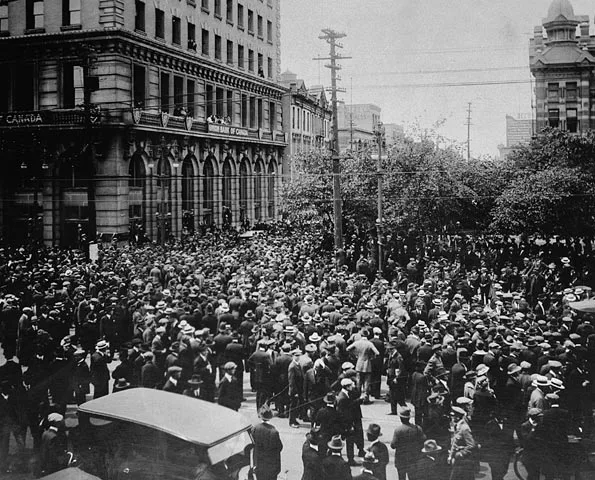
The boom ended in 1914. From May 15 to June 25, 1919, more than 30,000 workers walked off the job in the Winnipeg General Strike, the largest strike in Canadian history. On Bloody Saturday, June 21, police charged a crowd near City Hall, killing two people and injuring about 30.
The aqueduct opened in 1919 but cut Shoal Lake 40 First Nation off on an artificial island. Pine Street became Valour Road in 1925. The Depression hit Winnipeg hard until the Second World War.
Sources: The Canadian Encyclopedia: Winnipeg General Strike of 1919 · The Canadian Encyclopedia: Winnipeg · CBC News: A century of water, as Winnipeg aqueduct turns 100 · The Canadian Encyclopedia: Valour Road
Floods, Unicity and a new downtown (1945 to 2000)
In the 1950 flood, more than 100,000 people left the city. The Red River Floodway, built from 1962 to 1968, diverts high water around Winnipeg. It came close to being overwhelmed in the 1997 flood and was then expanded.
Stephen Juba, a Ukrainian Canadian, was elected mayor in 1956 as tensions between older and newer communities eased. In 1972 the old city and its suburbs merged into Unicity. The Forks was declared a National Historic Site in 1974, the Mint opened in 1976, Portage and Main was closed to pedestrians in 1979, and The Forks opened to the public in 1989. Susan Thompson became the first woman mayor in 1992, the Jets left in 1996, and Winnipeg hosted the Pan American Games in 1967 and 1999.
Sources: CBC News: Lessons from 5 of Manitoba's worst floods · The Canadian Encyclopedia: Winnipeg · The Canadian Encyclopedia: The Forks · Royal Canadian Mint: Celebrating 50 years of minting in Winnipeg · CP24: Portage and Main reopens to foot traffic (June 27, 2025)
Modern Winnipeg (2001 to today)
The NHL Jets returned in 2011. The Canadian Museum for Human Rights opened on September 19, 2014. The Blue Line rapid transit corridor opened in 2020.
In 2025, Portage and Main reopened to pedestrians on June 27 and the Primary Transit Network replaced almost all bus routes on June 29. Statistics Canada estimated the population at 850,260 on July 1, 2025.
Sources: The Canadian Encyclopedia: Winnipeg Jets · The Canadian Encyclopedia: Canadian Museum for Human Rights · City of Winnipeg: Winnipeg Transit launches the Primary Transit Network (includes the City's land and water acknowledgement) · CP24: Portage and Main reopens to foot traffic (June 27, 2025) · City of Winnipeg: Statistics Canada: Winnipeg tops 850,000 residents (January 20, 2026)
Historic places you can still see
- The Forks National Historic Site, including the market built from railway stables.
- The Exchange District, one of the most historically intact turn-of-the-century districts.
- Lower Fort Garry (the Stone Fort), where Treaty 1 was signed, north of the city.
- Valour Road, renamed in 1925.
- The Manitoba Legislative Building and the Golden Boy.
- The Royal Canadian Mint (1976).
Sources: The Canadian Encyclopedia: The Forks · The Forks: History · The Canadian Encyclopedia: Winnipeg · The Canadian Encyclopedia: Treaties 1 and 2 · The Canadian Encyclopedia: Valour Road · The Canadian Encyclopedia: Golden Boy · Royal Canadian Mint: Celebrating 50 years of minting in Winnipeg
Winnipeg timeline
| Year | Event |
|---|---|
| About 4000 BCE | People already gathering at The Forks |
| 1738 | La Vérendrye's Fort Rouge built at The Forks |
| 1810 | North West Company builds Fort Gibraltar |
| 1812 | Red River Colony founded |
| 1816 | Seven Oaks incident |
| 1862 | Henry McKenney's store at future Portage and Main |
| 1869 to 1870 | Red River Resistance led by Louis Riel |
| 1870 | Manitoba Act creates the province (May 12) |
| 1871 | Treaty 1 signed at Lower Fort Garry (August 3) |
| 1873 | Winnipeg incorporated as a city |
| 1877 | University of Manitoba founded |
| 1885 | Canadian Pacific Railway completed |
| 1911 | Winnipeg is Canada's third-largest city |
| 1914 | Harry Colebourn buys the bear Winnipeg |
| 1919 | Shoal Lake aqueduct opens; General Strike (May 15 to June 25) |
| 1925 | Pine Street renamed Valour Road |
| 1950 | Red River flood |
| 1968 | Red River Floodway completed |
| 1972 | Unicity amalgamation |
| 1976 | Royal Canadian Mint opens in Winnipeg |
| 1989 | The Forks opens to the public |
| 1997 | Flood of the century |
| 2011 | NHL Jets return |
| 2014 | Canadian Museum for Human Rights opens |
| 2025 | Portage and Main reopens to pedestrians; new transit network |
Sources: The Forks: History · The Canadian Encyclopedia: Winnipeg · The Canadian Encyclopedia: Red River Colony · The Canadian Encyclopedia: Red River Resistance · The Canadian Encyclopedia: Treaties 1 and 2 · The Canadian Encyclopedia: University of Manitoba · The Canadian Encyclopedia: Winnie-the-Pooh · The Canadian Encyclopedia: Winnipeg General Strike of 1919 · CBC News: A century of water, as Winnipeg aqueduct turns 100 · The Canadian Encyclopedia: Valour Road · CBC News: Lessons from 5 of Manitoba's worst floods · Royal Canadian Mint: Celebrating 50 years of minting in Winnipeg · The Canadian Encyclopedia: Winnipeg Jets · The Canadian Encyclopedia: Canadian Museum for Human Rights · CP24: Portage and Main reopens to foot traffic (June 27, 2025) · City of Winnipeg: Winnipeg Transit launches the Primary Transit Network (includes the City's land and water acknowledgement)
Questions about Winnipeg's history
When was Winnipeg founded?
Winnipeg was incorporated as a city in 1873. The settlement grew from the Red River Colony (1812) and a store built in 1862 at today's Portage and Main.
What Treaty is Winnipeg on?
Treaty 1, signed on August 3, 1871 between Canada and the Anishinabek and Swampy Cree of southern Manitoba.
How old is The Forks?
People have gathered at The Forks for more than 6,000 years; archaeologists found a 6,000-year-old hearth there.
Source: The Forks: History
What was the Red River Resistance?
A Métis-led movement in 1869 and 1870, headed by Louis Riel, that formed a provisional government and led to the creation of Manitoba.
What happened in the Winnipeg General Strike?
From May 15 to June 25, 1919, more than 30,000 workers walked out. Two people were killed on Bloody Saturday, June 21.
Source: The Canadian Encyclopedia: Winnipeg General Strike of 1919
What was the Red River Colony?
A settlement founded in 1812 by the Earl of Selkirk on land granted by the Hudson's Bay Company.
How bad was the 1950 Winnipeg flood?
More than 100,000 people, about a third of the city, fled, and the flood led to the Red River Floodway.
What is Unicity?
The 1972 merger of Winnipeg and its surrounding municipalities, including St. Boniface, into one city.
When did the Winnipeg Jets come back?
In 2011, when True North bought the Atlanta Thrashers and moved them to Winnipeg.
Why was Portage and Main closed to pedestrians?
Barricades went up in 1979 when the underground concourse opened. The intersection reopened to pedestrians on June 27, 2025.
Source: CP24: Portage and Main reopens to foot traffic (June 27, 2025)